Stadtpark
Back to all places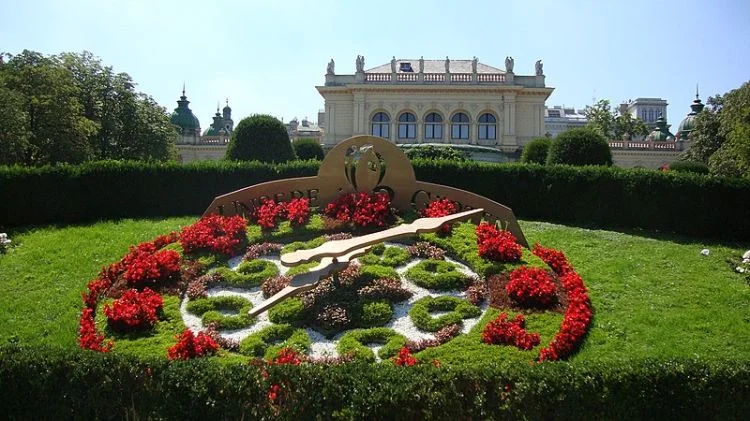
The City Park in Vienna meets every expectation of an "artificial landscape in the city". Court painter Joseph Selleny and garden director Rudolf Siebeck designed a municipal park where alternating small copses and grassy areas created a unique and varied setting.
Rudolf Siebeck, who was employed in 1861 as Vienna’s first municipal gardener, laid out the plans based on Selleny’s draft and led the subsequent work on the park’s construction. In 1861 the local council had accepted Joseph Selleny’s draft under the condition that the council should be allowed to make changes. In 1862 the city council purchased the famous cast-iron pavilion - exhibited at the London World Exhibition of 1851 - from Hermann Bergmann and set it up in the City Park. The park on the left bank of the River Wien was opened on 20 August 1862. In 1863 the so-called children’s park was added on the right bank of the Wien. The final layout was completed in 1872, when all the boscages, individual plantings and lawns and carpet-bedding had been finalised following completion of the "Kursalon" building and its surrounds.
After various bridge construction projects along the River Wien, the current overarching of the river was carried out by architects Friedrich Ohmann and Josef Hackhofer in 1906, creating an interesting promenade.
As was typical for the late nineteenth century, the numerous plantings and most especially the ornamental shrubs were selected to provide a flowering vista almost all year round, along with interesting decorative barks and fruits. The additions following the building-over of the River Wien by architects Friedrich Ohmann and Josef Hackhofer are important examples of Viennese Art Nouveau.
Today, the Stadtpark is regarded as a link between the city centre and the third district: pedestrians approaching the park from any side will find a different environment. Those emerging from the "Stadtbahn" railway pavilions will see Viennese Art Nouveau in its purest form. Those entering the park from the third district cross a hilly section of the park to find a contemporary steel sculpture by Donald Judd. Approaching from Ringstrasse one must penetrate shady paths to come suddenly upon the airy park meadows and the popular Johann Strauss monument. Vienna’s Stadtpark offers an everchanging landscape on various levels. The history of its evolution was also ever-changing.
https://www.wien.gv.at/english/environment/parks/stadtpark.html
Photo: Palacrogalin
48.20473, 16.37966